
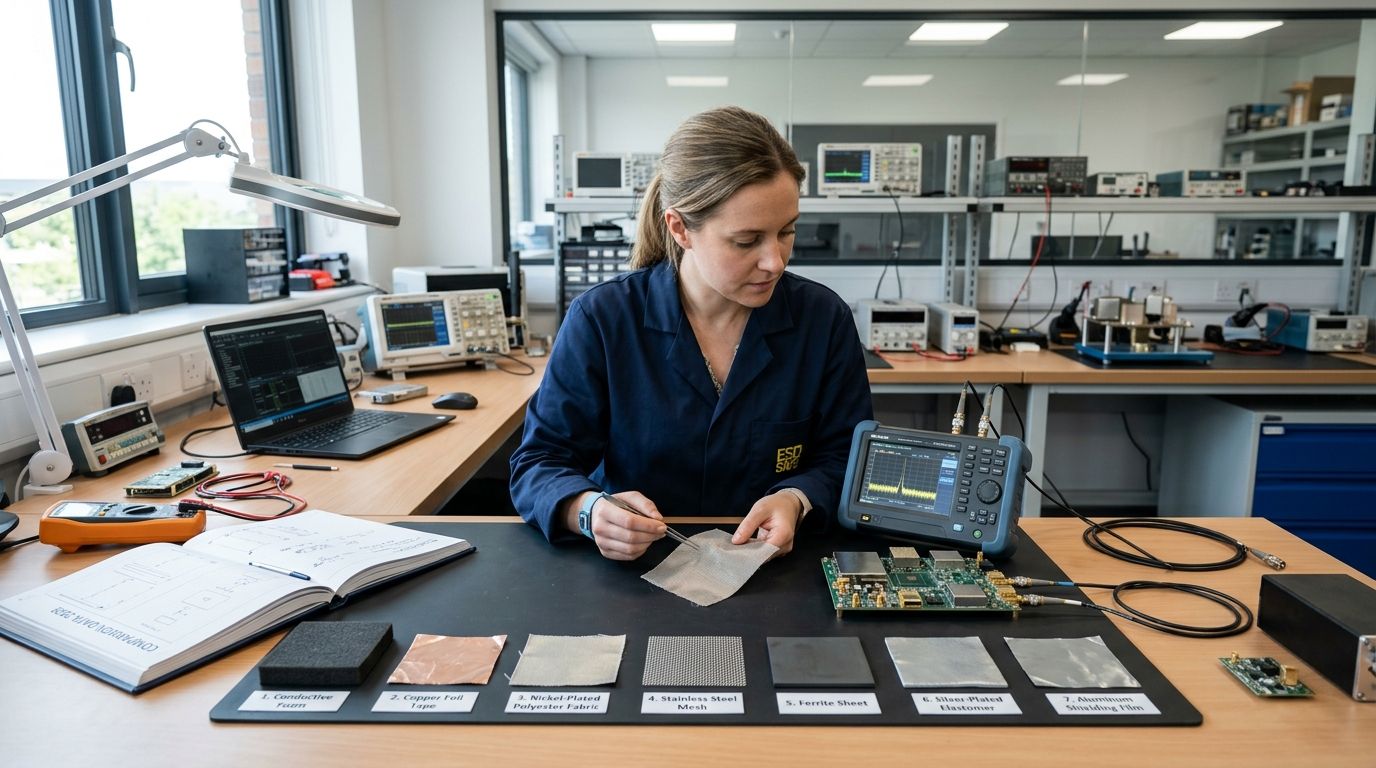
Choosing the right RF shielding material in 2026 comes down to one question: are you blocking electric fields, magnetic fields, or both, and at what frequency? This comparison ranks seven material classes engineers actually specify — from conductive fabrics to mu-metal — against distinct use cases so you're not guessing which one fits your enclosure, chamber, or medical suite.
- Nickel-copper-silver plated fabric wins for flexible RF shielding materials in enclosures and portable setups.
- Copper mesh remains the default for permanent shielded rooms needing broad-spectrum attenuation.
- Mu-metal is the only real answer for low-frequency magnetic shielding near MRI and medical imaging equipment.
- Carbon-loaded RF absorbing foam is built for anechoic chamber testing, not structural shielding.
- Conductive elastomer gaskets solve the seam and door-gap problem every enclosure eventually runs into.
Why this matters
Most shielding failures in 2026 aren't caused by picking a bad material — they're caused by picking the right material for the wrong frequency range or joint type. A copper mesh room with unshielded seams performs worse than a mediocre fabric applied correctly. MWT Materials builds RF absorbers, shielding textiles, and coatings for aerospace, defense, medical imaging, and telecom clients, and the pattern repeats across every sector: engineers over-invest in the panel material and under-invest in the seam, gasket, or door.
This guide separates the seven material classes by what they're actually good at, not by marketing claims.
What makes the best RF shielding materials
- Attenuation range at target frequency — a material rated for 1 GHz may do nothing at 100 MHz.
- Field type — electric field, magnetic field, or plane wave shielding require different physics.
- Flexibility and installability — rigid materials shield better per unit thickness but can't wrap curved enclosures or moving parts.
- Corrosion and environmental resistance — outdoor telecom cabinets and medical suites age differently than lab benches.
- Weight — matters for aerospace and portable test setups, irrelevant for permanent shielded rooms.
- Seam and joint compatibility — the material is only as good as its weakest connection point.
At a glance
| Material | Best for | Standout feature | Key limitation |
|---|---|---|---|
| Ni-Cu-Ag plated fabric | Flexible enclosures & portable shielding | Conformable to curves and seams | Wears at high-flex points over time |
| Copper mesh | Permanent shielded rooms | Broad-spectrum attenuation, well-understood physics | Rigid, heavy, needs structural backing |
| Mu-metal | Low-frequency magnetic shielding | High magnetic permeability | Loses effectiveness if bent or dropped |
| Carbon-loaded RF absorbing foam | Anechoic chamber testing | Absorbs rather than reflects RF energy | Not a structural shield on its own |
| Conductive elastomer gaskets | Enclosure seams & doors | Maintains contact under vibration | Only solves joints, not panels |
| Aluminum foil laminate | Large-surface broad shielding | Easy to apply over large areas | Lower attenuation than copper at high frequency |
| Silver-plated ripstop fabric | Lightweight portable tents/bags | Very low weight-to-attenuation ratio | Less durable under repeated abrasion |
1. Nickel-copper-silver plated fabric: best RF shielding material for flexible enclosures
This conductive textile wraps around curved housings, cable bundles, and moving assemblies where rigid panels can't go. It's the category MWT Materials builds shielding textiles around, because the plating stack gives conductivity close to solid metal without the weight or rigidity penalty.
Ni-Cu-Ag fabric pros:
- Conforms to complex geometry without seams
- Sews, laminates, or heat-bonds into existing enclosure designs
- Holds attenuation performance across a wide frequency band
Ni-Cu-Ag fabric cons:
- High-flex points can wear the plating over repeated cycles
- Requires proper grounding at every termination to avoid gaps
Verdict: Buy for enclosures, gaskets, or wearable RF shielding where rigid panels aren't an option.
2. Copper mesh: best for permanent shielded rooms
Copper mesh is the reference material for MRI suites, SCIF construction, and telecom test rooms because engineers have decades of published attenuation data to design against. It typically delivers 60 to 100 dB of attenuation across a broad RF band when installed as a continuous enclosure.
Copper mesh pros:
- Predictable, well-documented performance
- Handles both electric and magnetic field components at higher frequencies
- Long service life with no plating to wear off
Copper mesh cons:
- Heavy and rigid — needs structural framing
- Expensive to retrofit into existing rooms
Verdict: Buy for new-build shielded rooms; Hold if you're retrofitting a space with limited structural capacity.
3. Mu-metal: best for low-frequency magnetic shielding
Mu-metal is a nickel-iron alloy with very high magnetic permeability, which makes it the only practical option for shielding low-frequency magnetic fields near MRI magnets and sensitive medical imaging equipment. Copper and aluminum barely touch magnetic fields at these frequencies — mu-metal is built specifically for that gap.
Mu-metal pros:
- Handles magnetic field shielding nothing else on this list can
- Standard material in medical imaging suite construction
Mu-metal cons:
- Bending or dropping the sheet degrades its permeability permanently
- Does little for high-frequency electric field or plane wave shielding
Verdict: Buy for magnetic field problems specifically; Skip if your issue is high-frequency RF, not magnetic flux.
4. Carbon-loaded RF absorbing foam: best for anechoic chamber testing
This material absorbs RF energy instead of reflecting it, which is exactly what anechoic chambers need to eliminate multipath reflections during antenna and EMC testing. It's a testing-environment material, not a shielding material for enclosures.
RF absorbing foam pros:
- Reduces reflected energy for cleaner test measurements
- Available in pyramidal and flat configurations depending on frequency range
RF absorbing foam cons:
- Doesn't block RF from passing through a wall — it absorbs what's already inside the chamber
- Bulky compared to fabric or foil options
Verdict: Buy for chamber and test-lab applications; Skip if you need a structural shield.
5. Conductive elastomer gaskets: best for enclosure seams and doors
Every rigid enclosure eventually has a door, hatch, or seam, and that's where shielding effectiveness usually collapses. Conductive elastomer gaskets maintain electrical contact across the joint even under vibration and repeated open-close cycles.
Elastomer gasket pros:
- Maintains contact pressure through thousands of cycles
- Available in profiles matched to specific door and panel geometries
Elastomer gasket cons:
- Solves joints only — doesn't shield the panel itself
- Compression set over years can reduce contact pressure
Verdict: Buy alongside any rigid shielding system; never treat it as a standalone solution.
6. Aluminum foil laminate: best for large-surface broad shielding
Aluminum foil laminate covers large drywall or panel surfaces cheaply and is common in commercial shielded-room construction where copper's cost becomes prohibitive at scale.
Aluminum laminate pros:
- Fast to apply over large square footage
- Lower material cost per square foot than copper mesh
Aluminum laminate cons:
- Lower attenuation than copper at higher frequencies
- Seams require careful taping with conductive tape to avoid gaps
Verdict: Hold for budget-constrained large rooms; Buy copper mesh instead when attenuation requirements are strict.
7. Silver-plated ripstop fabric: best for lightweight portable shielding
Silver-plated ripstop is built for field tents, transport bags, and portable Faraday enclosures where weight matters more than long-term durability. It's the lightest option on this list per unit of attenuation.
Silver-plated ripstop pros:
- Very low weight for its shielding performance
- Packs and folds without permanent creasing damage
Silver-plated ripstop cons:
- Abrasion wears the silver plating faster than nickel-copper alternatives
- Not suited for permanent structural installations
Verdict: Buy for portable and field-deployed shielding; Skip for fixed installations.
How we ranked
Each material was scored against the six criteria above — frequency range, field type, flexibility, environmental resistance, weight, and seam compatibility — then matched to the use case where it outperforms the other six, not where it merely competes.
Get help specifying your shielding material
Talk through frequency range, field type, and enclosure geometry before you buy.
Which RF shielding material should you choose?
For most enclosure and portable shielding projects in 2026, nickel-copper-silver plated fabric is the default because it conforms to geometry that rigid materials can't reach. If you're building a permanent shielded room, copper mesh is still the standard. If the problem is magnetic field leakage near medical imaging equipment, nothing on this list substitutes for mu-metal. Match the material to the field type and frequency first — the rest of the decision follows from there.
FAQ
What is the best RF shielding material for flexible enclosures?
Nickel-copper-silver plated fabric is the best RF shielding material for flexible enclosures in 2026 because it conforms to curved and moving geometry without seams. Copper mesh and mu-metal are rigid and don't wrap complex shapes.
Is copper mesh better than aluminum foil for shielded rooms?
Copper mesh delivers higher attenuation at higher frequencies than aluminum foil laminate, making it the better choice for strict shielding requirements. Aluminum foil laminate is a lower-cost option for large surfaces where requirements are less strict.
Does mu-metal shield high-frequency RF signals?
No, mu-metal is built for low-frequency magnetic field shielding, not high-frequency RF or plane wave shielding. Copper mesh or conductive fabric handle the high-frequency side of the problem.
Why do shielded rooms fail even with good wall materials?
Most shielded room failures happen at seams, doors, and cable penetrations, not the panel material itself. Conductive elastomer gaskets and proper grounding at every joint are what keep the room's rated attenuation intact.
Can RF absorbing foam replace structural shielding?
No, RF absorbing foam absorbs energy already inside a space, like an anechoic chamber, but it does not block RF from passing through a wall. Structural shielding requires copper mesh, foil laminate, or conductive fabric.
What shielding material is lightest for portable use?
Silver-plated ripstop fabric is the lightest RF shielding material on a weight-to-attenuation basis, making it the standard choice for field tents and transport bags. It trades some durability for that weight savings.
How often does mu-metal need to be replaced?
Mu-metal doesn't wear out on a schedule, but its magnetic permeability degrades permanently if the sheet is bent, dropped, or mechanically stressed. Handling damage, not age, is the main failure mode.
Do conductive fabrics corrode over time?
Nickel-copper-silver and silver-plated fabrics can show plating wear at high-flex or high-abrasion points over years of use, though environmental corrosion resistance is generally strong. Proper grounding and handling extend service life significantly.
One last thing
The material spec sheet is never the whole story — the joint between two shielded panels is where most real-world attenuation gets lost in 2026 installations. Before locking in a material choice, ask what happens at every seam, door, and cable penetration in the design, because that's where the rated performance either holds or quietly disappears.